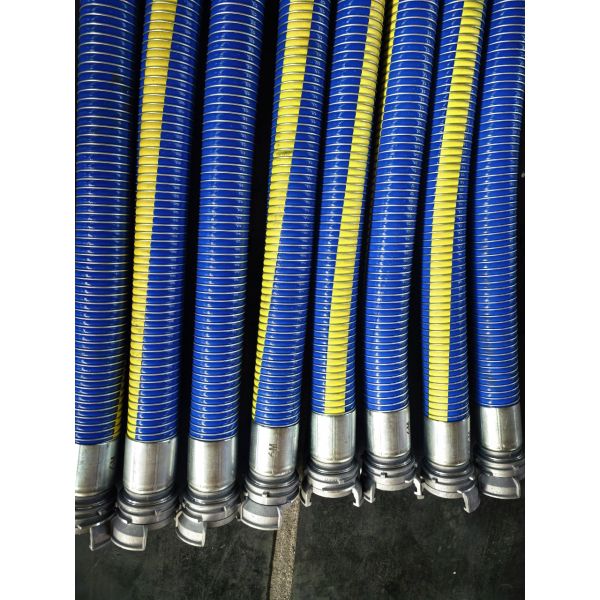
High Pressure Multipurpose Composite Flexible Hose Versatile for Oil Gas Water Pipeline Systems
This oil resistant hoses rely on high quality, high reliability,and safety to enhance our reputationin the field of oil transportation, We use oil resistant performance that is superior to The syntheticmaterial of NBR rubber supplies products to users, and nylon inner layer material can be provided forspecialreguirements.
Recommended use
Widely used for transporting fuel, oil, liquid vapor, hydrocarbon products such as gasoline, diesel. kerosene, crude oil, etc., positive and negative pressure does not affect use Static design.
| TYPE | GGP | GPS | SSP |
| Innerringsteelwire | Hot-dip galvanized steel wire | Galvanized steelwire | Polypropylene |
| Outer ring steel wire. | Hot-dip galvanized steel wire | Stainless steel wire | Polypropylene |
| Innerlayer material | Polypropylene | Polypropylene | Polypropylene |
| Applicable temperature: —30°C~+100°C Working pressure: 150psi, 220psi |
| Specification:linch~10inches |
INSTRUCTIONS FOR USING HONGTAICOMPOSITE HOSE
1,Usage detection:Hongtai hose has the characteristics of safety and durability. lf it is not installed and used correctly, itwil not only shorten its service life, but may also have more serious consequencesBefore starting touse,please read and understandin detail,andreferto allinstructions,warnings,and relevant safetoperation regulations for use.The hose should be in a natural straight or bent state, and it is prohibitedto use it when the pipe body is twisted or at the minimum bending radius.When the hose needs to besuspended, a special lifting device should be used to hang it in a suitable position, and the use ofa single rope for suspension is prohibited.When the connection between the hose and the pipeline isat a certain height from the ground, a support should be used to cushion it to avoid excessive bendingof the hose.When using hoses, they should avoid sharp edges or dock ship guardrails and be supportedwith supports.When the hose is connected to the ship at the dock, it should be lifted with a specialsling to avoid the ship shaking, squeezing, and breaking the hose.When the hose is suspended betweentwo joints of the pipeline, there should be support or a special sling in the middle ofthe hose, especiallywhen the hose is too long,Do not use hoses suspended in the air.
2,Appearanceinspection:
- 1.Check for any dents or distortions in the pipe body.
- 2.Check for corrosion, wear, and looseness of the spira stee wire.
- 3. Check for any abnormal phenomena such as leakage, cracks, corrosion, deformation, etcin the joint.
- 4. Check for leakage in the pipe body and excessive wear of the reinforcement layer.
- 5. Whether the inner laver of the pipe has been corroded and detached.lf the hose exhibitsany of the above phenomena or other abnormal features, it must be stopped from use.
3,Stress testing:
- 1. Clean the hose thoroughly and test whether there is conductivity between the two ends ofthe joint (non-conductive is prohibited from proceeding to the next step of testing)
- 2. Place the hose flat on a test bench that allows the hose to move freely.
- 3. Fill the hose with clean water, seal the joints at both ends, and empty the air inside the hose
- 4. Apply pressure to 1.5 times the maximum working pressure of the hose, and there should beno leakage in the hose After the hydrostatic test, the water should be removed to keep theinside of the pipe dry.
- 5.Before, during, and after the water pressure test, the conductivity between the two joints ofthe hose should be tested simultaneously.
- 6. The hose should undergo a comprehensive inspection at least once every 6 months, and thetest data should be recorded and saved during the testing process.
- 7. Composite hoses are made of thermoplastic elastomer hoses, and there will be a certainamount of elongation during the pressure testing process, which is a normal phenomenonand cannot be used as hosesThe criteria for continued use.
4,Storage:
- 1. Clean before storage and ensure that the inside of the tube is dry (please request cleaning methodsfrom Hongtai).
- 2. lf not used for a long time, it should be stored in a dry room with a flat surface and light shielding.
- 3.When storing hoses outdoors, shelters should be set up to minimize long-term exposure to sunlight
5,Repair:After the Hongtai hose is damaged, it may be possible to repair it, but it must be carried out by anapproved engineer.
6,Waste disposal:
The inner laver of some of Honatai's chemical composite hoses is made of fluoropolymer PTFEwhich generates HF COF2 when the normal operating temperature exceeds 205 ℃~260 ℃cToxicgas. When using hoses or handling related waste, it is necessary to comply with the laws andregulations of the local country and region, which should be carried out by professionaldepartments or recycled by Hongtai,Burning and discarding are prohibited.
Technical Parameters
| I.D (MM/IN) | Max. WP. (psi/Mpa) | Blasting Pressure (psi/Mpa) | Reference Weight (kg/m) | Bending Radius (mm) |
| 25/1 | 150/1.03 | 600/4.2 | 0.9 | 100 |
| 38/1.5 | 150/1.03 | 600/4.2 | 1.5 | 110 |
| 51/2 | 150/1.03 | 600/4.2 | 1.8 | 125 |
| 65/2.5 | 150/1.03 | 600/4.2 | 2.5 | 150 |
| 76/3 | 150/1.03 | 600/4.2 | 2.3 | 200 |
| 100/4 | 150/1.03 | 600/4.2 | 9.9 | 500 |
| 150/6 | 150/1.03 | 880/6.06 | 1.2 | 100 |
| 25/1 | 220/1.516 | 880/6.06 | 2.0 | 120 |
| 38/1.5 | 220/1.516 | 880/6.06 | 2.2 | 180 |
| 51/2 | 220/1.516 | 880/6.06 | 2.5 | 260 |
| 65/2.5 | 220/1.516 | 880/6.06 | 3.0 | 260 |
| 76/3 | 220/1.516 | 880/6.06 | 5.0 | 400 |
| 100/4 | 220/1.516 | 880/6.06 | 14 | 600 |
| 152/6 | 220/1.516 | 880/6.06 | 22 | 800 |
| 202/8 | 220/1.516 | 880/6.06 | 27 | 1100 |
| 252/10 | 220/1.516 | 880/6.06 | | |